“I’m too old to contribute to a TFSA…”
“I don’t have spare cash to invest…”
“I want to leave a legacy, but I don’t have enough…”
These are common concerns advisors hear and yet, in many cases, there is a simple and often overlooked solution: the Tax-Free Savings Account (TFSA).
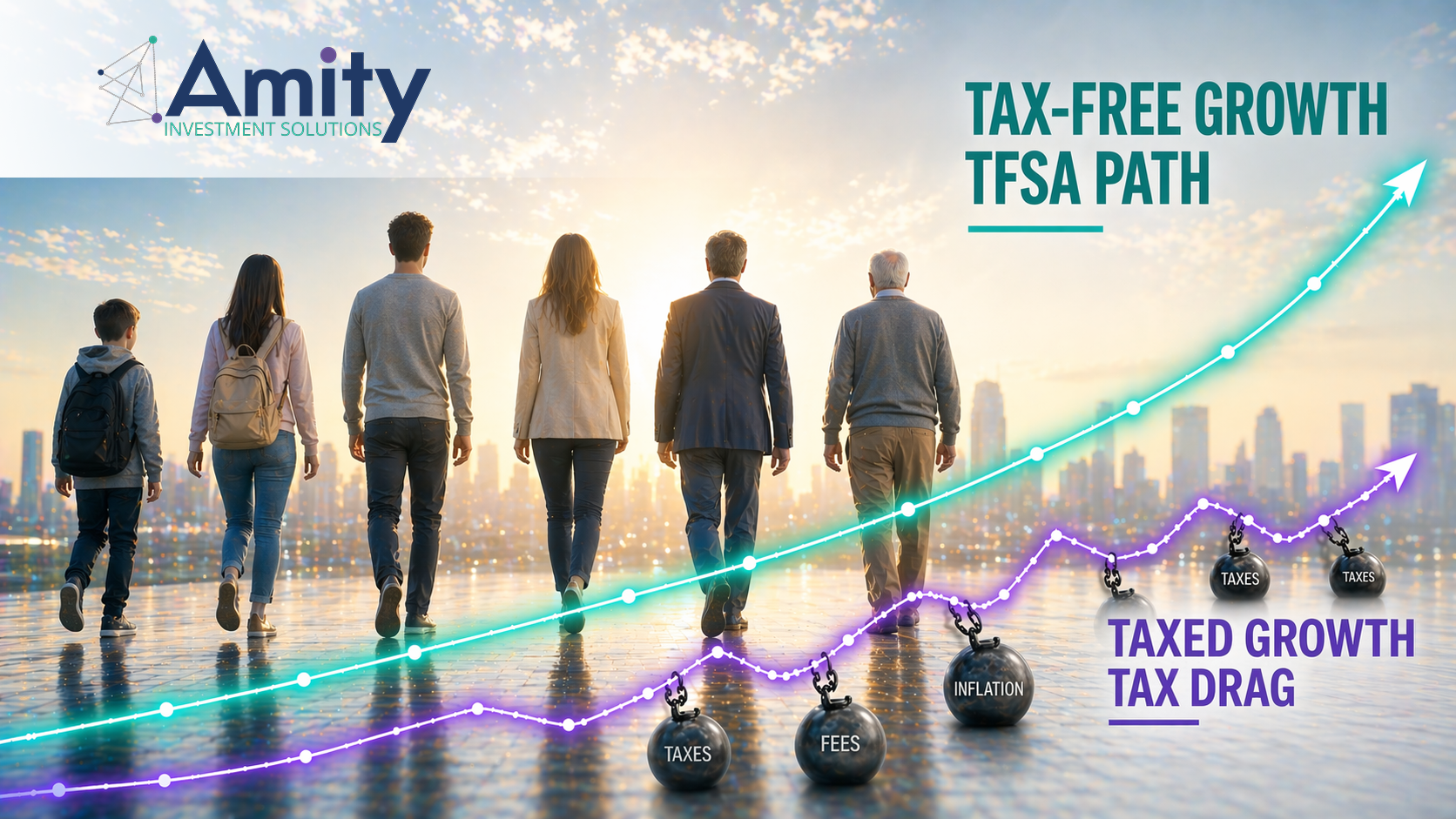
Most investors are familiar with TFSAs. In simple terms, a TFSA allows individuals to invest up to the prescribed limits, with all growth (interest, dividends and capital gains) completely tax-free. Despite this powerful benefit, TFSAs are still underutilised or misunderstood.
In this article, we explore why a TFSA may be more valuable than it appears at first glance, how it can be used effectively across different scenarios, and which practical rules matter most in 2026.
1. “I’m too old to contribute to a TFSA” – A common myth
TFSAs are often seen as a vehicle for younger investors with long time horizons. This perception is misleading.
Consider a 50-year-old investor contributing R46,000 per tax year until the R500,000 lifetime TFSA limit is reached, and then allowing the investment to compound until age 65:

Over time, the tax drag on a discretionary investment significantly reduces returns. Even over a relatively shorter investment horizon, the TFSA remains highly competitive.
*Assumption: Any tax saving generated by the retirement annuity is not reinvested.
Takeaway: Age is not a barrier. The tax-free nature of a TFSA makes it a valuable addition to almost any portfolio.
2. “I don’t have spare cash to invest…” – A planning opportunity
A lack of available cash flow is a legitimate constraint, but it does not necessarily mean you cannot contribute to a TFSA.
One effective strategy is tax harvesting within an existing discretionary portfolio.
For example:
• You hold an investment worth R1.2 million with a base cost of R1.0 million.
• Each year, you realise capital gains up to the annual CGT exclusion (R50,000).
• You reinvest the proceeds into a TFSA, within the allowable annual limits.
Link to article about tax harvesting: http://amityoldsitecoza.local/saving-tax-beyond-tax-free-savings-and-retirement-products/
Over time, this strategy gradually shifts assets from a taxable environment into a tax-free one without requiring additional savings.
This approach should still be implemented carefully, with due regard to transaction costs, asset allocation and the investor’s wider tax position.
Takeaway: Funding a TFSA does not always require new money. In many cases, it can be achieved through smarter structuring of existing investments.
3. “I want to leave a legacy, but I don’t have enough…”
Many investors want to leave a meaningful legacy but are concerned about compromising their own financial security.
A TFSA can be a highly effective intergenerational planning tool.
Consider a 70-year-old gifting R46,000 per tax year into a grandchild’s TFSA until the grandchild’s R500,000 lifetime TFSA limit is reached:

In practice, the contribution is made to the grandchild’s TFSA and uses the grandchild’s annual and lifetime TFSA allowances. The combination of long-term compounding and tax-free growth can create substantial value over time, even from relatively modest contributions.
Takeaway: A TFSA can be a powerful way to build generational wealth without placing pressure on your own retirement capital.
Final thoughts
The TFSA is one of the most flexible and tax-efficient investment vehicles available. Whether you are:
- starting young,
- starting later in life,
- working with limited available capital, or
- looking to build a financial legacy,
A TFSA can play a meaningful role in your overall strategy.
The key is not just understanding what a TFSA is, but recognising how it can be used creatively and effectively in different circumstances.
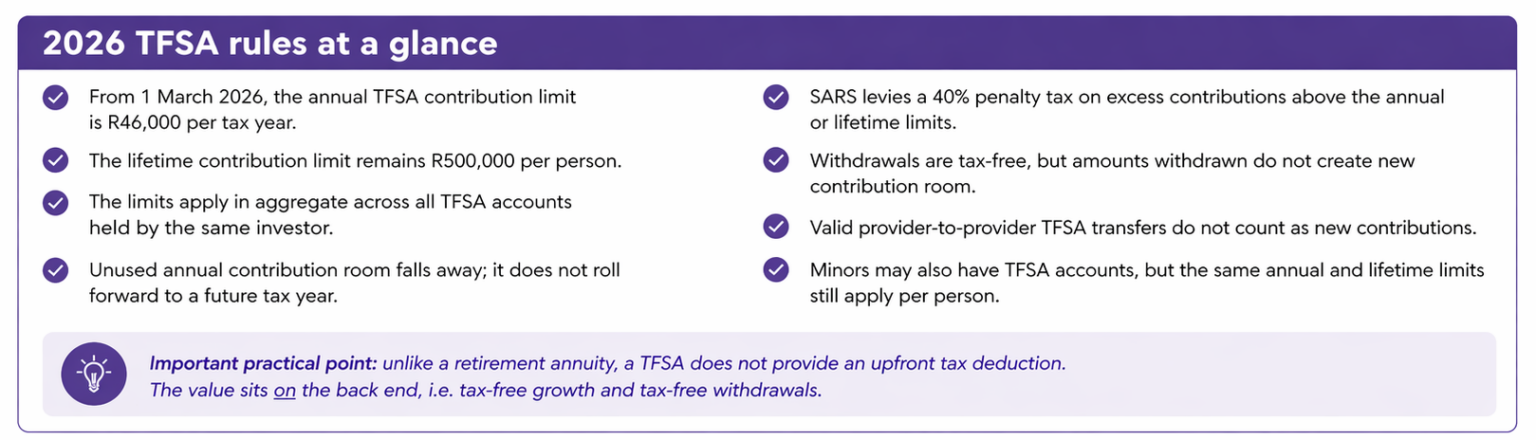
With the annual allowance now increased to R46,000 per tax year, the case for using the TFSA allowance consistently has become even stronger.
Assumptions
- Illustrations reflect the TFSA annual contribution limit of R46,000 per tax year from 1 March 2026 and the lifetime limit of R500,000.
- Where annual contributions would otherwise exceed the lifetime limit, contributions stop once cumulative contributions reach R500,000.
- Investment growth: CPI + 4–5%.
- CPI: 5%.
- Growth composition: 75% capital, 12.5% interest, 12.5% dividends.
- Fees are excluded.
- Rules reflected in this article are current as at March 2026.